Green Faith in Morocco: When religions unite to conserve water

In El Jadida's El Mellah neighborhood, inside the old Portuguese city, the sea was close enough to leave its smell on the damp stones. There, at the ancient cistern, a little tale of water began, not as an abstract environmental subject, but as a daily practice that could bring different people together in one meaning.
At that point, the imam of the neighborhood mosque, Abd al-Salam, stood next to Eliyahu from Ben Simon Synagogue, along with volunteers from nearby alleys. The meeting did not have a festive character, nor did it come within the framework of a major campaign, but it was based on a specific and clear idea, to reduce water consumption in places of worship, and to plant seedlings capable of tolerating the salinity of the Atlantic coast near the mouth of the um al-Rabi River.
It all started with the details. A wooden plaque that Khadija had installed on a stone wall overlooking the seaside had written a short phrase in Arabic that translates to: "Water is mercy, do not be wasteful." Next to it, at the small lamp restored by the volunteers, the imam inspected the new meter, while Eliyahu wrote on another tablet the words: "Bal Tashchit," a moral rule in Jewish tradition that forbids corruption and waste. Between the two phrases, and between the tap and the meter, the whole scene seemed to translate the idea from the level of preaching to the level of Verb.
The Imam said, contemplating the tap, "We bring down the verse from the sermon to the water, and then we count the drop." Eliyahu replied, "The worship that you love is measured. I have been fattened, do not spoil a drop or a habit." Thus, in a country where water has become a pressing daily affair, interfaith dialogue has taken a simpler and more concrete form, a partnership that begins with the rationalization of consumption and extends to caring for the earth.
Mercy measured by the meter
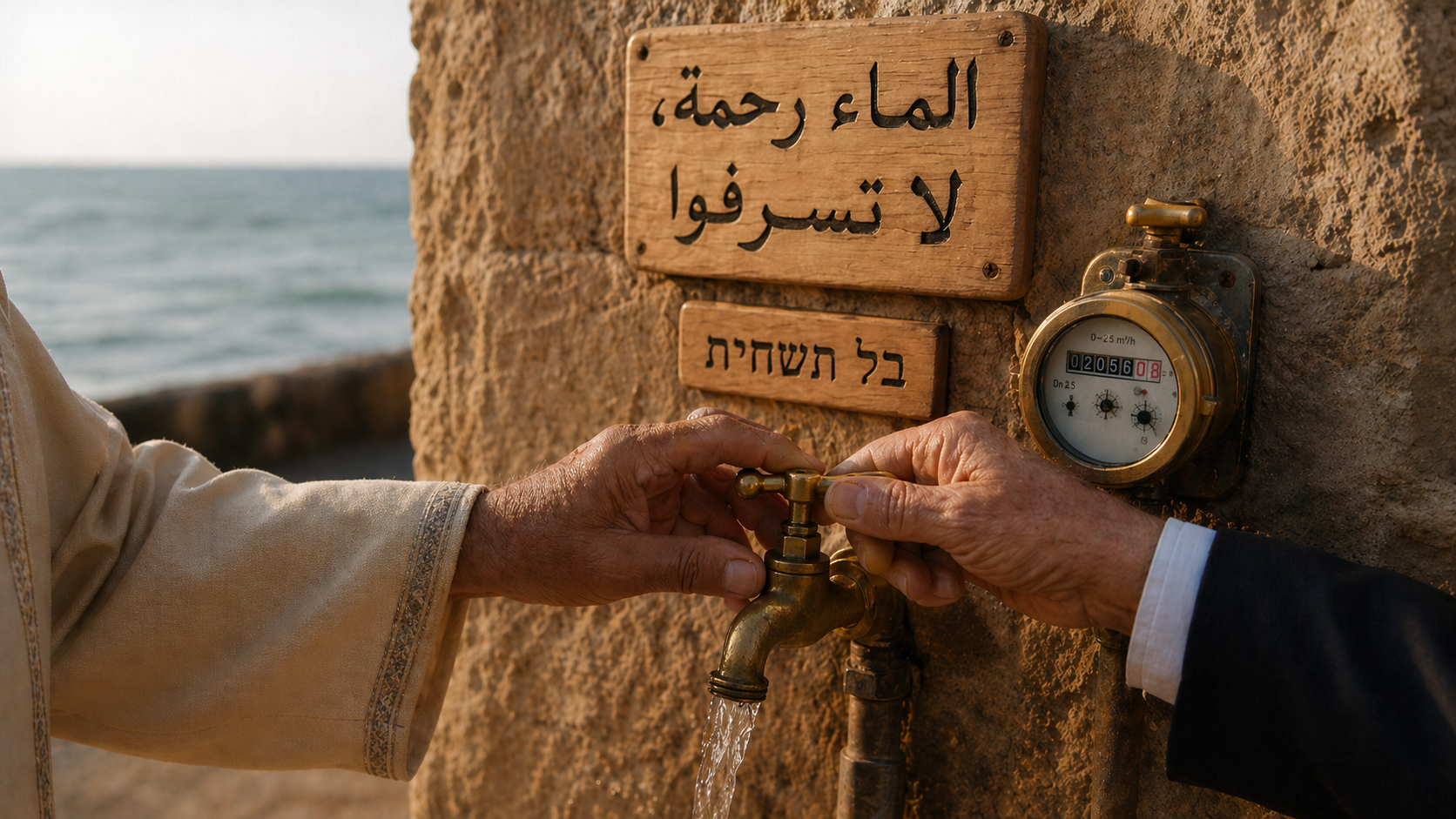
"Water is mercy, do not be wasteful."
Since mid-July 2025, the counting has already begun. Every Friday after the afternoon prayer, the number would be recorded, and then a single piece of paper would be hung on the door of the mosque and synagogue together, including the date, the reading of the counter, and the difference from the previous week. There were no banners and no lengthy statements, just a small trace that was repeated week after week, leaving the numbers to say enough.
A few weeks later, the change began to be evident. Water consumption dropped by 15 to 20 percent. It wasn't just the number that was striking, but the way it became part of the life of the neighborhood. On the wooden door of the mosque, the white paper hung with delicate green lines that rose and fell like a faint pulse. No logo and no official stamp, just the number of the week and a handwritten reading. The children would stop in front of it to see if the line went up or down, as if they were following something of their own.
The idea then spread from the worship spaces to the eastern bank of um al-Rabi', near the new arch of Azmour. There, the group planted seedlings that tolerate salt, wind, tarfa, raghal, and samar. Hamza, the environmental technician who accompanied the volunteers, said, "Planting is easy, it's hard to keep the tree." He then went on to explain how each seedling needed a circle of stones to keep the dew and a balanced watering in its early days. Then Eliyahu whispered to a boy holding a jar of water: "Do not extinguish the hope of the tree by haste," the Imam added, "and do not be extravagant, water with a dream." Leveling stones around one of the seedlings, Khadija would say simply: "Different hearts hold the same pickaxe."
Mustafa, one of the young people in the neighborhood who took part in the restoration, summed up the impact of the experience on his own way: "We have never heard a sermon about the environment in our lives, but this time we saw it in the lighthouse. Water has become a measure of love, not just ablution." In that sentence, the initiative seemed to succeed in something more than rationalization itself, it moved the environmental idea from the level of general advice to the level of lived experience.
Um Al Rabie Charter
In the old navigator, where memory hangs in antique wooden walls and doors, participants gathered at the Ben Simon Synagogue to forge what looks like a small local pledge. It was not a heavy document, but a single page titled "The Mother of Spring Charter," topped with a brief phrase: "Draft model until adoption."
The clauses were clear and straightforward: the conservatization of water in places of worship, an announced weekly measurement, a joint planting on the two banks, and a rotating schedule between the mosque, the synagogue and the association to track watering and care. When Imam Abd al-Salam signed for the mosque and Eliyahu signed for the synagogue, with the consent of their local councils, the signing was not so much an administrative measure as it was a symbolic indication that joint responsibility sometimes begins with a simple agreement, if there is someone to take it seriously.
The first copy of the charter hung near the cistern on the stone wall. While everyone was contemplating the pending paper, a man in his fifties from the neighborhood asked the most realistic question: "And who will water in two weeks when the enthusiasm is over?" The imam did not answer with a long speech, but rather raised a small piece of paper with a table of days and tasks, and said with a smile: "We do not teach intentions, we divide the days." The answer was enough to restore the initiative from the level of symbolism to its practical logic, continuity is not based on emotions alone, but also on organization.
By the end of August, the impact on the ground was too obvious to explain. On both banks of the river, between Azemmour and Sidi Bouzid, about 80 percent of the seedlings were still alive. There was no music, no slogans, only a brief applause, and a few eyes that sparkled as they saw that something small was beginning to prove itself. Eliyahu said at the time: "I love faith when it leaves a handprint, not a trace of a tongue." Abdeslam replied: "The house has changed, and the numbers are witness." Then the weekly bulletin returned to its place on the door of the mosque and synagogue, following the curve quietly, as if it were an additional prayer that only those who pass by will hear soon.
Neighborhood Challenge
As the weeks passed, the initiative lost its original form as a new event, and gained something more entrenched, a habit. Watering is done according to a schedule hung at the door of the association, and the volunteers rotate the days as if they are reviewing fixed dates in their daily lives. It is no longer a matter of the enthusiasm of the beginnings, but of a quieter, more continuous rhythm.
In order to give the experience a wider dimension within the neighborhood, Khadija announced what she called the "neighborhood challenge." The idea was simple and clever: a family that manages to reduce their household water consumption within a month has the right to name a seedling on the bank. Thus, the initiative went from the mosque and synagogue to the homes, and from the symbolic realm to the details of daily consumption within the families.
Little by little, the wall was filled with small pictures and names engraved on wooden boards near the slender trunks. Grandparents' names, names that evoke family memory and connect them to the ground. One quiet evening, an elderly woman stood in front of a sapling bearing her name. She read the name slowly, put her hand on the plank, then on her grandson's shoulder, and walked away without saying a word. It was one of those moments that didn't need to be explained, because she was explaining herself.
The most beautiful moment in the experiment was not only the moment the number appeared, but the way it was displayed. In the mosque, a handwritten white paper reads in Arabic a text that translates to: "Cycle: a decrease of about 15 to 20 percent." Underneath it, a small line that adds with a loving lightness: "Thank God, and to the lashes of the faucet that have been repaired." Eliyahu laughed when he read it, and said, "This is an excellent theological lesson." Abd al-Salam replied, "This is the most beautiful jurisprudence of my day." Khadija wrote down an equation in her notebook that summarized everything that had happened: "Mercy = counter + rotation table + name on a seedling".
The Promise of the Drop
In the evening, everyone returned to the Portuguese cistern from which the story began. The walls of the Kasbah caught the last light of the sunset, while the water of um al-Rabi' gleamed on the horizon near the new arch – Azmour. There, Khadija placed a small file on the edge of the basin, which looked ordinary in shape, but carried the memory of the whole experience, the meter readings, the pictures of the planting, the notice of the provider, and the coordinates of the seedlings planted near the bank.
"No big promises, just a path that repeats," she said as she sorted out the papers. In that particular sentence, the essence of the initiative seemed clearer than any other description. This was not a tale of the environment as a separate file from faith, nor of religion as a discourse suspended above everyday life. It was simply a tale of values that found their way to the earth.
Here, the verse on the tap is no longer just a moral reminder, and the phrase "pal is fattened" is no longer just a heritage reference. The two have become part of a daily behavior, of a drop being counted, of a seedling being watered, and of a joint effort that connects the mosque, the synagogue, the neighborhood and the river. On the same bank, between El Jadida and Azmour, the imam, Eliyahu and Khadija remained watching the young seedlings move with the wind.
Eliyahu said, "You are fat, do not spoil." Abd al-Salam replied, "And do not be extravagant." Khadija smiled and said, "Arzug is safe." Then, as always, calm returned.
Every month, Khadija would come back to the tank to talk the file and add a new sheet to the register. There was no evaluation team, no big administrative language, just a counter and a conscience, she said with a smile. Then the tap was gently closed.
The drop remains a promise that can be returned, measured, and built upon.