Flavors of Coexistence: How did migrant cuisines create one Egyptian feast that welcomes everyone?

The warm aroma of spices drifts along Abbas El; Akkad Street in Nasr City; one of Cairo’s main commercial arteries; forming a strange yet familiar blend: the smoky smell of charcoal; grilled shawarma mingles with the rich smell of mandi rising from underground ovens.
Soft music plays somewhere nearby. As you draw closer, the sound sharpens; Fairuz singing “We Breathe the Air.” Her voice pulls you in, and before you know it, you’re seated, eating manakish with meat and mint, generously squeezed with lemon juice, feeling instantly refreshed. This is how Egyptians learned to enjoy it; from Lebanese bakeries.
In Beirut, once known as the “Paris of the East,” entire neighborhoods have been reduced to rubble. The roads that once echoed with music now resound with explosions, and those who never imagined leaving have been forced into exile.
Here, on a single street in Cairo, the aromas of Levantine spices blend with the heat of Yemeni flavors, while Egyptian, Syrian, Yemeni, Palestinian, and other Arabic dialects intertwine in a lively hum.
On Egyptian soil, the hardships of migration and displacement have transformed into something remarkable: a unique cultural phenomenon. The Egyptian table has become a living bridge of understanding; where people pause at and admire the colors of food, not at the color of passports or religion.
These restaurants are more than businesses; they are small cultural hubs that nurture acceptance and quietly dissolve the boundaries between nationalities.
Inside Taj El Sham restaurant in Nasr City, words are hardly needed. A glance into the kitchen tells the story: an Egyptian and a Syrian chef working side by side, sharing tools and laughter in equal measure.
A Syrian worker decorates the space. He came from Aleppo; a city once known as a hub of industry and trade before war reduced its historic markets to ruins. When he fled, he carried only what many Syrians do: a family photo, a handful of spices, and memories that cannot be erased.
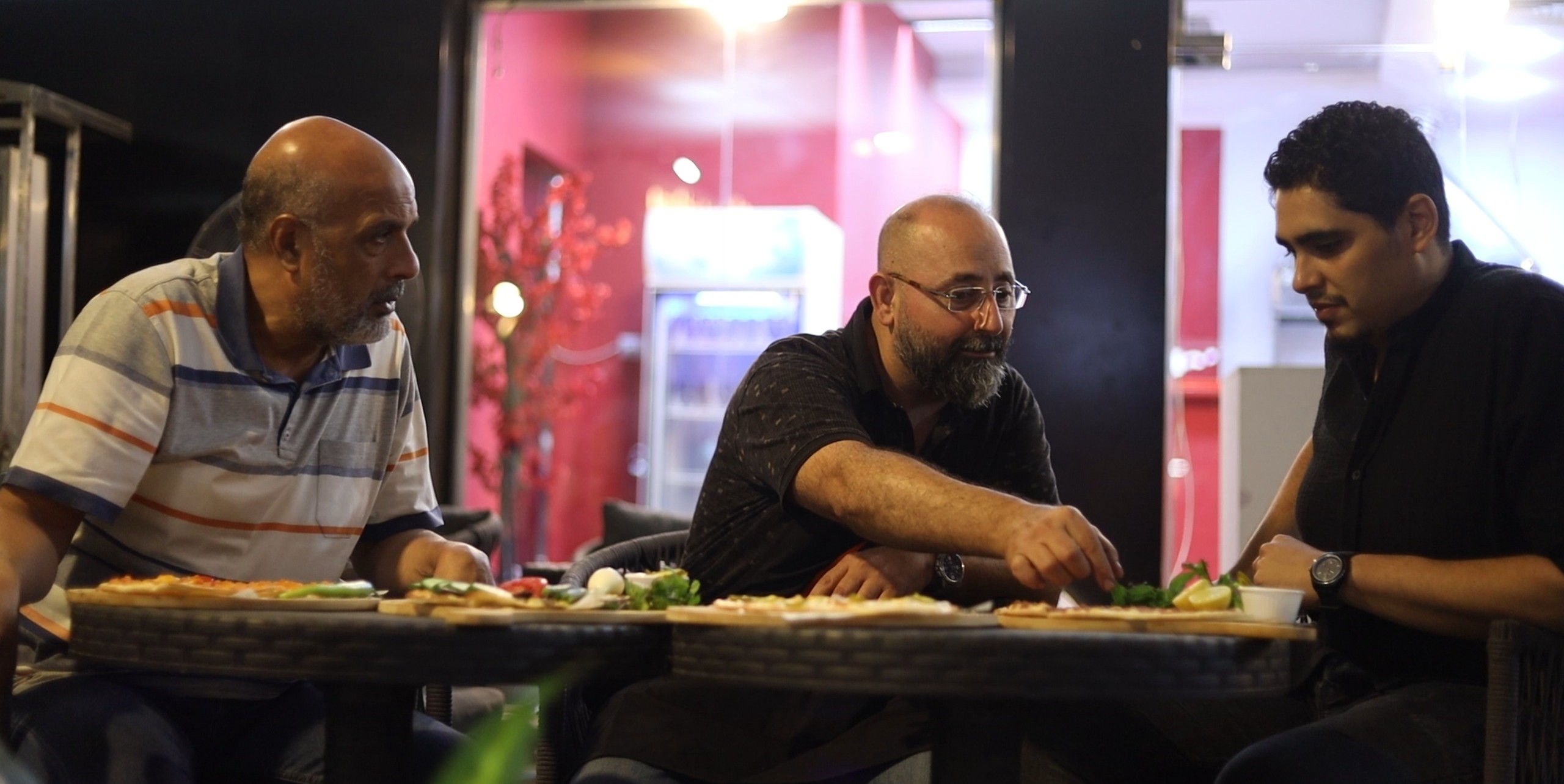
Lebanese and Egyptians friends gather to enjoy Lebanese manakish in Egypt. Photography @ Abdullah Alaa.
“When we came to Egypt, no one asked me about my religion,” he says, turning meat on the skewer. “We are Syrians, they are Egyptians; but we’ve always felt like one people. You feel at home here.”
In a Lebanese restaurant nearby, the spirit revolves around the idea of “lamma”; togetherness. Zakaria Itani, who runs Liqma restaurant in Beirut, describes how the restaurant became a substitute for home.
“We didn’t open this place just to make a living,” he says, his voice carrying more than his words reveal. “It’s about gathering people. When Egyptians sit with us, the sense of exile fades. We remind each other of a brotherhood that war tried to take away.”
Lebanese and Syrian restaurants don’t just bring Levantine flavors; they also employ Egyptian staff, creating a genuine exchange of skills. Egyptian chefs learn the art of kibbeh, while Syrians discover the secrets of Egyptian fuul and ta’ameya.
A few meters away, a Palestinian restaurateur stands over an upturned tray, his eyes reflecting both pride and something deeper than nostalgia. Behind him hangs a Palestinian flag, while the air carries the scent of cumin and coriander.
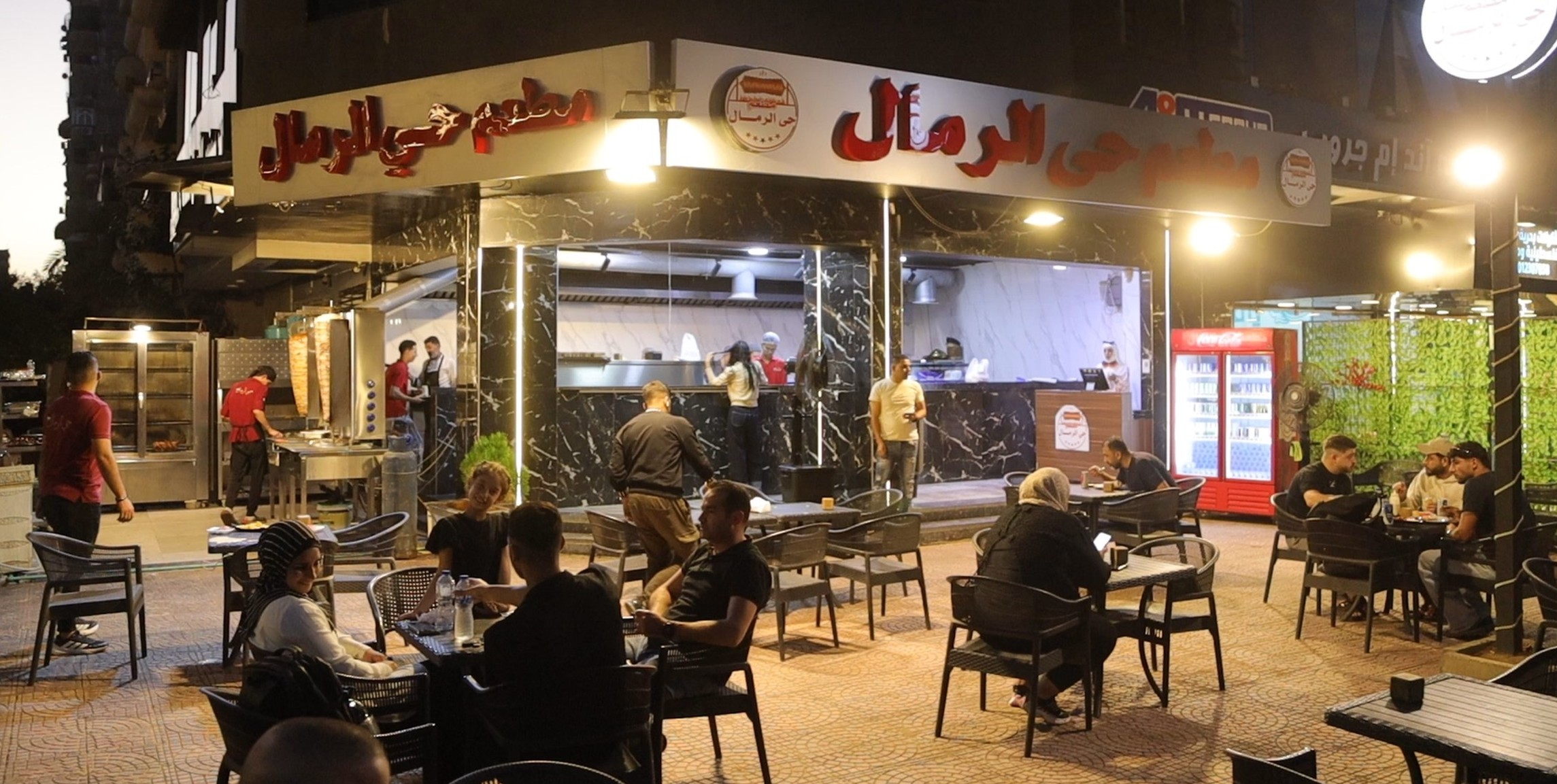
Palestinian Resteraunt Hay Al-Rimal in Egypt. Photography @ Abdullah Alaa.
Bassel Abu Al; Aoun, owner of a restaurant in Nasr City’s Rimal district, comes from Gaza; a place where violence continues, where neighborhoods are shattered daily, and where displaced families in Rafah and Khan Younis wait for meals that may never arrive.
“I don’t just serve Palestinian dishes,” he says. “I serve a piece of my homeland. Egyptians and Arabs feel nostalgic for it; and that support means everything.”
In the corner, an Egyptian customer finishes a plate of musakhan. He may not know the full story behind it, but he knows the meal was worth the journey.
Three years ago, Yasmine Mahmoud knew nothing about Palestinian cuisine. Today, she stands at the heart of the same restaurant, a shawl embroidered in the colors of the Palestinian flag draped over her shoulders.
“I’m Egyptian, and proud,” she says. “But working here made me want to learn; not just the food, but the spirit behind it. Palestinians work as if every opportunity is their last. That taught me something about how to work, too.”
Yemeni mandi is nothing like its Libyan counterpart, yet both find a place side by side on the streets of Cairo.
Yemen, torn apart by years of war and humanitarian crisis, and Libya, still struggling for stability since the fall of its regime; both carry wounds that have yet to heal.
In one corner, a Yemeni underground oven releases the scent of burning wood. Nearby, a Libyan chef explains the details of bazin to a curious customer, using his hands and a warm smile when words fall short.
Two cuisines, distant in geography and culture, yet united by stories of migration and longing. Here, coexistence is not a slogan; it is lived daily, over open flames and shared meals.
The Sudanese restaurant offers a different experience from the moment you enter. It’s not just the food; it’s the way people gather. Tables are larger, seating is longer, and the atmosphere is warmer. There is something of an ancient African communal tradition in the space, making strangers feel not like visitors, but invited guests.
Beyond conference halls and peace dialogues, true coexistence is born elsewhere: in the kitchen.
Syrian shawarma, Yemeni mandi, Sudanese dishes, and Palestinian maqlouba have not come to compete with Egypt’s rich culinary heritage; but to enrich it, to expand its table.
At this extended table, there is a place for every storyteller, every person carrying their homeland in memory and in heart.
You leave Abbas El; Akkad Street carrying more than you came for: your stomach full, your memory richer, and something like hope quietly taking root where you least expected it.
Today, more than six million refugees and migrants live in Egypt, according to the United Nations High Commissioner for Refugees. They fled wars they did not start, bringing with them what bombs cannot destroy: a mother’s recipe, the scent of home cooking, and the will to begin again.
At this table, each of them found a seat; one that no one asked for by name, but that was always waiting.
This is Egypt.