When did dialogue stop including listening, and why does this urgently need to change?

The international landscape is going through one of the most critical and turbulent periods in our recent history. We are witnessing a deep fragmentation of the global system, where multilateralism and diplomacy appear to be retreating at an alarming pace.
The conclusions of Amnesty International’s latest report, The State of the World’s Human Rights 2025/26, leave little room for doubt. International law is under threat, civil society is facing increasing pressure, and a global order marked by authoritarianism, mistrust and the erosion of fundamental rights is gaining ground.
To reverse this tragic course, the answer does not lie in the spread of wars or in the imposition of noisy narratives that sell the illusion of protecting peace while fueling division. On the contrary, the most radical and effective answer available to us remains the courage to engage in dialogue.
However, meaningful dialogue must involve actively listening to others in an environment of genuine trust. Dialogue is not spinning. It is not a distraction, nor is it a way to construct and impose a narrative. It is the effort to actively listen to the other. It is a method. It is rigorous and patient work. It is mutual understanding in search of solutions that are genuinely acceptable to both sides.
The question remains: when did we lose the ability to truly listen to one another?
We do not know exactly when it happened. But what we can be sure of is that peace begins with humility to recognise that no one holds a monopoly on truth.
History repeatedly teaches us that peace is not a state of inertia or a guarantee already secured, but rather an active construction and, in most cases, a silent one. In a world where narratives openly contradict one another, and where truth increasingly depends on each person’s perceived reality, mistrust between states has become the new normal. The real challenge is not technical or military. It is relational.
It is about recovering, step by step, the ability to bring people to the same table without this being interpreted as weakness.
We live in a time of constant noise, where polarisation replaces reasoning and speed replaces depth. Decades of diplomacy teach us a simple and uncomfortable lesson: no agreement could endure if the people affected by it do not recognise their own dignity within it. This, and not only the text of treaties, is what turns a ceasefire into peace.
In this urgent context, interreligious and intercultural dialogue must be seen as a strategic asset. When religious leaders, policymakers and specialists sit at the same table and engage in honest dialogue, they affirm globally that religion can, and must, be a formidable force for cohesion, rather than merely an instrument of division.
This is not well-intentioned rhetoric. There are spaces of trust, religious communities, cultural networks and shared identities that the state cannot always reach. A legitimate mediator, rooted in the community and recognised by the people, can open doors where formal diplomacy often finds walls.
Consider the impact of the recent Papal visit to Africa: when the Pope speaks, the world listens. His message goes beyond the boundaries of Catholicism and reaches every corner, inspiring acts of solidarity and concord. In an international context marked by growing pressure and boycotts against multilateral cooperation forums, the need to strengthen partnerships that value identity, culture and mutual understanding become increasingly clear.
Finally, we must not underestimate what happens at the local level. It is in communities, not in the corridors of major conferences, that peace becomes real or falls apart.
Protecting sacred sites, promoting religious literacy and supporting local mediators are not minor actions. They are the ground on which diplomacy meets people’s lives. And it is precisely there, in that meeting point between the global and the human, that dialogue stops being a concept and becomes transformation.
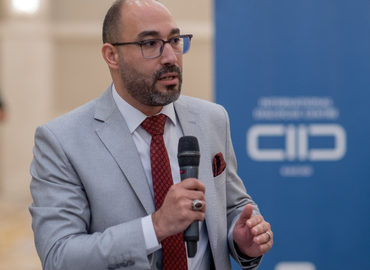
Hani Dawah, Deputy to the Senior Media Counsellor of the…