Should Journalists Have an Active Role in Building Peace? KAICIID Launches Flagship Policy Paper on Media and Interreligious Dialogue

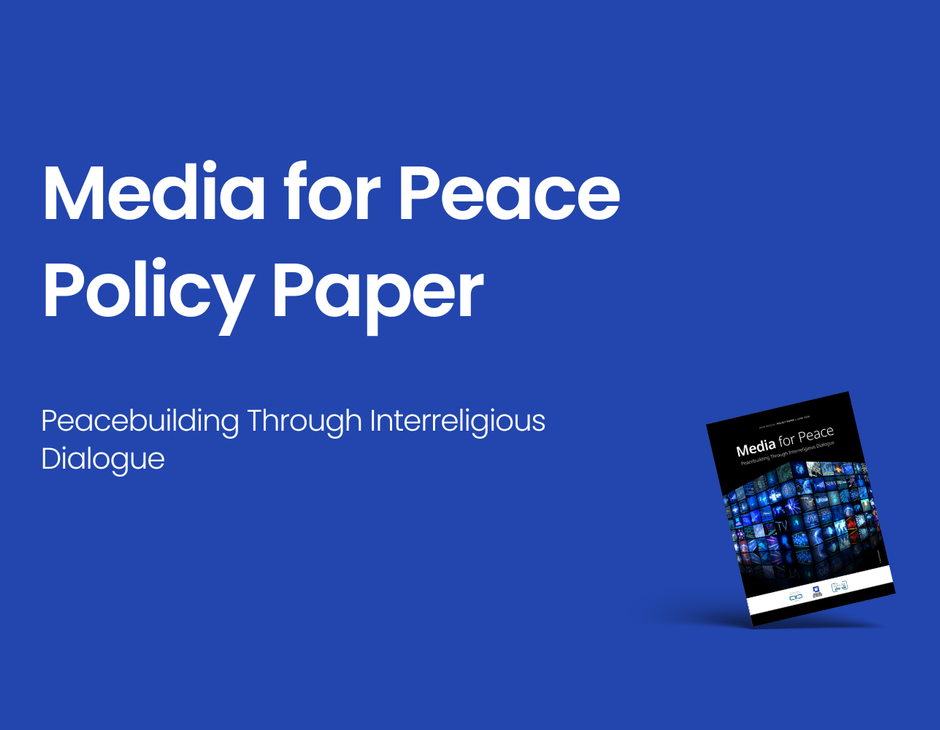
A new policy paper from KAICIID's Dialogue Journalism Fellowship calls on media institutions worldwide to treat peacebuilding as a core editorial responsibility and shows exactly how that transformation can happen.
At a time when news cycles are dominated by conflict, polarisation and division, a timely new policy paper from the International Dialogue Centre - KAICIID - makes the case that the media is one of the most powerful and underutilised levers for peace in the world today.
Launched in June 2026 by KAICIID's Dialogue Journalism Fellowship, part of the work by the Arab region programme, the ‘Media for Peace: Peacebuilding Through Interreligious Dialogue’ draws on extensive research, expert interviews and field insights to map the untapped potential of media as a driver of social cohesion. While rooted in the experience of the Arab region, the paper's findings and recommendations carry urgent relevance for media institutions, policymakers and civil society organisations across the globe.
The Problem: Progress Locked Away from the Public
Over thirty years, the region has produced remarkable interfaith achievements: In 2003, King Abdullah bin Abdulaziz launched National Dialogue Forum initiative, resulting in several key initiatives including the 2007 meeting with Pope Benedict XVI at the Vatican leading to the formation of King Abdullah bin Abdulaziz International Centre for Interreligious and Intercultural Dialogue (KAICIID) in 2012), the 2008 Mecca Conference and Madrid World Conference on dialogue, and the 2019 Mecca Declaration/Charter. In 2017, Al-Azhar issued a declaration stating that all citizens deserve equal rights regardless of religion or ethnicity, rejecting discrimination and extremism. In 2019, Pope Francis and the Grand Imam of Al-Azhar jointly signed a document calling for peace and mutual respect between all people, emphasising shared humanity over religious differences.
According to the paper, media narratives can sometimes prioritise conflict and sensationalism over stories of collaboration and coexistence. In highly polarised contexts, complex political, social and economic tensions may also be presented primarily through a religious lens, obscuring deeper root causes and reinforcing public misunderstanding. At the same time, dialogue initiatives are sometimes perceived as politically motivated or elite-driven, rather than grounded in the realities and needs of everyday communities.
The result: a public largely unaware that progress is being made, and a peace architecture that lacks the popular foundation it needs to become durable.
"The media has the power to transform public understanding of cultural and religious diversity and coexistence," said Maya Sukar: Programme Officer – KAICIID Arab Region. "Yet that power remains systematically underutilised. This paper is a call to action for journalists, editors, religious institutions and policymakers to build a new kind of partnership, one that puts peace at the centre of the editorial mission of pluralism and peace."
Three Ways Media Can Help Change This
The policy paper identifies three pivotal roles that media can play in transforming this landscape:
-
Simplify and Humanise: Complex theological concepts and interreligious declarations should not remain the preserve of educated elites. Through storytelling, short-form digital content, and accessible language, media can translate these ideas into daily life, making coexistence feel real, relatable and relevant.
-
Bridge Divides: The media has a unique power to create shared spaces for structured, respectful dialogue, giving platforms to religious leaders who champion tolerance, countering extremist narratives with credible voices, and mainstreaming messages of mutual respect that challenge hate speech and stereotyping.
-
Amplify Voices and Initiatives: Grassroots peacebuilding initiatives across communities rarely receive the coverage they deserve. When the media actively spotlights local, regional and global initiatives in interfaith work, it multiplies impact; empowering communities, inspiring replication and building the kind of public trust that sustains peace.
-
“Peacebuilding cannot remain confined to conference rooms, policy papers or formal dialogue spaces. For dialogue to take root, it must reach the public through stories that are accurate, ethical and grounded in lived realities. This policy paper recognises journalists as essential partners in that process, not only as observers of conflict, but as actors who can help communities better understand one another, challenge harmful narratives and create space for coexistence,” said Waseem Haddad, Senior Programme Manager, KAICIID Arab Region.
How KAICIID Is Responding
KAICIID's Dialogue Journalism Fellowship has been at the forefront of building the bridge between journalism, social cohesion and peaceful coexistence. The Fellowship equips journalists across the Arab region with the skills to report on religious diversity with sensitivity, accuracy and constructive intent through interreligious dialogue. It is one of several KAICIID programmes that put this belief into practice: that trained, ethical journalists, dialogue practitioners and digital communicators are among the most effective peacebuilders of our time. These include the alongside the KAICIID Fellows Programme, which has trained over 550 fellows from more than 90 countries, and Social Media as a Space for Dialogue, which equips participants, particularly across the Arab region, with the skills to use social media to counter hate speech, promote dialogue and strengthen social cohesion.
The policy paper was developed in collaboration with KAICIID's Interreligious Platform for Dialogue and Cooperation (IPDC) and reflects insights gathered from a joint session of journalists and religious dialogue experts held in Amman, Jordan, in April 2025.
The urgency to act — Across Regions and Sectors
The paper's recommendations extend well beyond the newsroom. They call on religious institutions to invest in media communications capacity; on governments and civil society to advocate for media policies that support ethical, peace-oriented journalism; and on all stakeholders to build the sustained partnerships, between media professionals (including journalists), faith leaders and communities, that are needed to promote peaceful coexistence in the public sphere.
The paper reflects KAICIID's core conviction: that when reported with ethical integrity on religious and cultural diversity, journalism has the potential to empower citizens, strengthen communities and contribute to lasting peace. As the paper notes: the media's potential to shape public opinion in favour of coexistence remains underutilised, but that can change.
Download Media for Peace: Peacebuilding Through Interreligious Dialogue at www.kaiciid.org
Learn more about the Dialogue Journalism Fellowship | Contact: [email protected]