Ahead of a KAICIID panel at the European Academy of Religion (EuARE) 2026 in Rome, scholars and religious leaders make the case that the “software” of trust and dialogue is as decisive as the “hardware” of migration policy.
The most difficult borders are not always those drawn on maps. Sometimes they are the invisible borders that shape the way we interpret reality.
Migration is one of the defining issues of our time, with few debates that divide European societies more sharply. Governments are struggling with labour shortages, demographic decline and the demands of integration, while public conversation grows more polarised. Yet one part of the response is easy to overlook: the everyday relationships, trust and shared values that decide whether newcomers and host communities can actually live well together.
The "hardware" of migration policy cannot hold without the "software" of trust and shared values, and interreligious dialogue is how that software gets built.
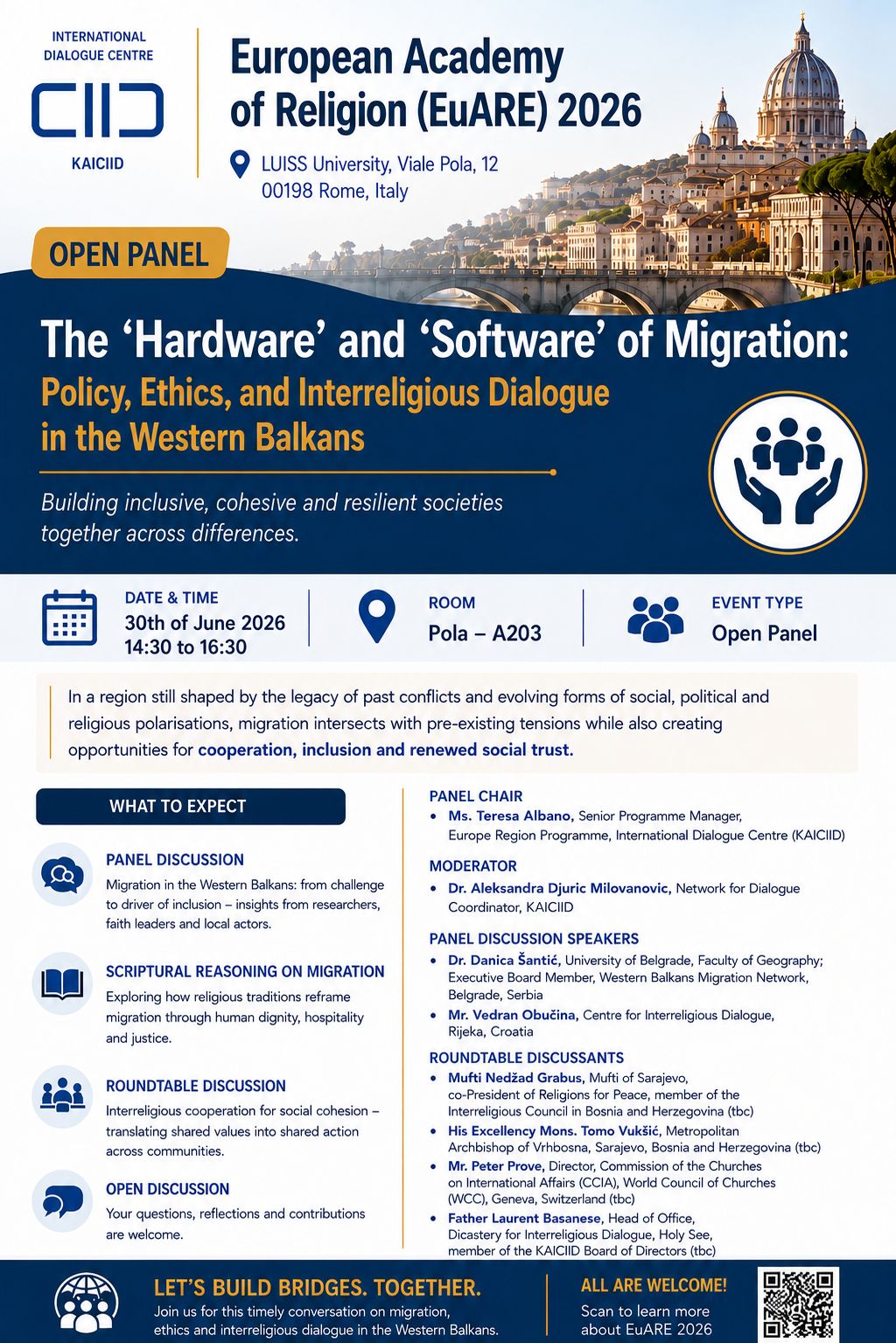
That is the starting point for an open panel convened by the International Dialogue Centre – KAICIID at the EuARe 2026 in Rome. The premise is simple. Effective migration governance needs the “hardware” of policies, institutions and services. It also inevitably demands the “software” of trust, ethical narratives and interreligious cooperation. Without the second, the first rarely holds.
Why the Western Balkans
This challenge is especially live in the Western Balkans, where the pressures closely mirror those across the rest of Europe. The region is experiencing demographic decline and labour shortages, continues to lose working-age people to emigration in a steady brain drain, and is at the same time becoming a transit and destination area for migrants and refugees. These shifts unfold while EU governments roll out the EU Pact on Migration and Asylum, and while societies across the region still carry the legacy of the conflicts of the 1990s.
That history still weighs on the present. The divisions left by the conflicts of the 1990s have not closed, and the arrival of migrants and refugees can amplify and magnify them. This is precisely why the panel treats migration as a test of social cohesion. In a region where trust remains fragile, the question is whether new arrivals deepen old fault lines or open space for encounter, and that is a question Europe is increasingly asking too.
Building trust through embracing connection
This year marks the 75th anniversary of the 1951 Refugee Convention, which makes the questions the panel raises especially timely and offers a meaningful occasion to reflect on them. Migration is a social cohesion issue, not only a policy one: laws can regulate movement and status, but they cannot by themselves generate belonging or acceptance. Religious leaders are frequently the ones to support the needs of migrants and refugees, offering support, social networks and spaces for encounter, long before formal systems take effect. When faith leaders cooperate visibly across religious boundaries, they can counter xenophobia, reduce polarisation and model a culture of hospitality.
The closing message is forward-looking. The next frontier, speakers suggest, is not simply helping migrants, but empowering them as active contributors to the communities they join.
Dialogue at the centre
This is where interreligious and intercultural dialogue, the core of KAICIID's mandate, comes in. The panel treats dialogue not as an exchange of pleasantries but as a practical method for building trust across communities. Bringing together religious leaders alongside researchers and practitioners, it asks how religious traditions themselves can be engaged on the question of migration. Father Vedran Obučina's work on Scriptural Reasoning, for instance, draws on sacred texts across traditions to reframe migration as a shared human and ethical question, while other speakers describe a shift from dialogue as recognition toward active interreligious engagement, where faith leaders take joint responsibility for social cohesion.
Seen this way, interreligious dialogue is not separate from the migration debate. It is one of the means through which shared values of dignity and hospitality are translated into concrete action.
The voices on the panel
Teresa Albano, Senior Programme Manager for the Europe Region Programme at KAICIID, opens and frames the session and moderates the concluding roundtable. The panel discussion is moderated by Dr. Aleksandra Djuric Milovanovic of KAICIID.
With contributions from Dr. Danica Šantić of the University of Belgrade, on emigration, labour shortages and the role of religious leaders in countering xenophobia and supporting evidence-based policymaking; Father Vedran Obučina, a KAICIID Fellow, on Scriptural Reasoning and human dignity beyond legal status; and Protodeacon Mladen Kovacevic, on the move from interreligious dialogue to active interreligious engagement, where faith leaders act as bridge-builders for shared values.
The roundtable brings these threads together with Dr. Nedžad Grabus, Mufti of Sarajevo and Co-President of Religions for Peace; Torsten Moritz, Director of the Churches Commission for Migrants in Europe; Lejla Hasandedic-Dapo of the United Religions Initiative; and Stefano Volpicelli of the Antonianum University. The aim is practical: how can societies respond to uncertainty without losing their capacity for solidarity?
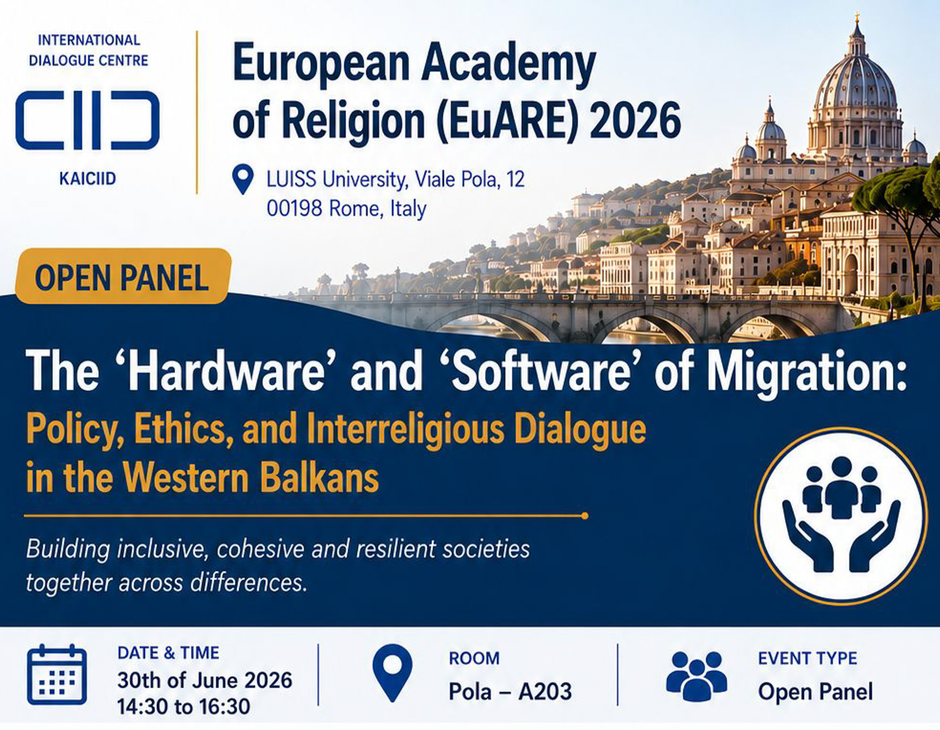
The panel “The ‘Hardware’ and ‘Software’ of Migration” takes place on 30 June 2026, 14:30 to 16:30, in Room Pola (A203) at LUISS Guido Carli University, Rome, as part of EuARe 2026.