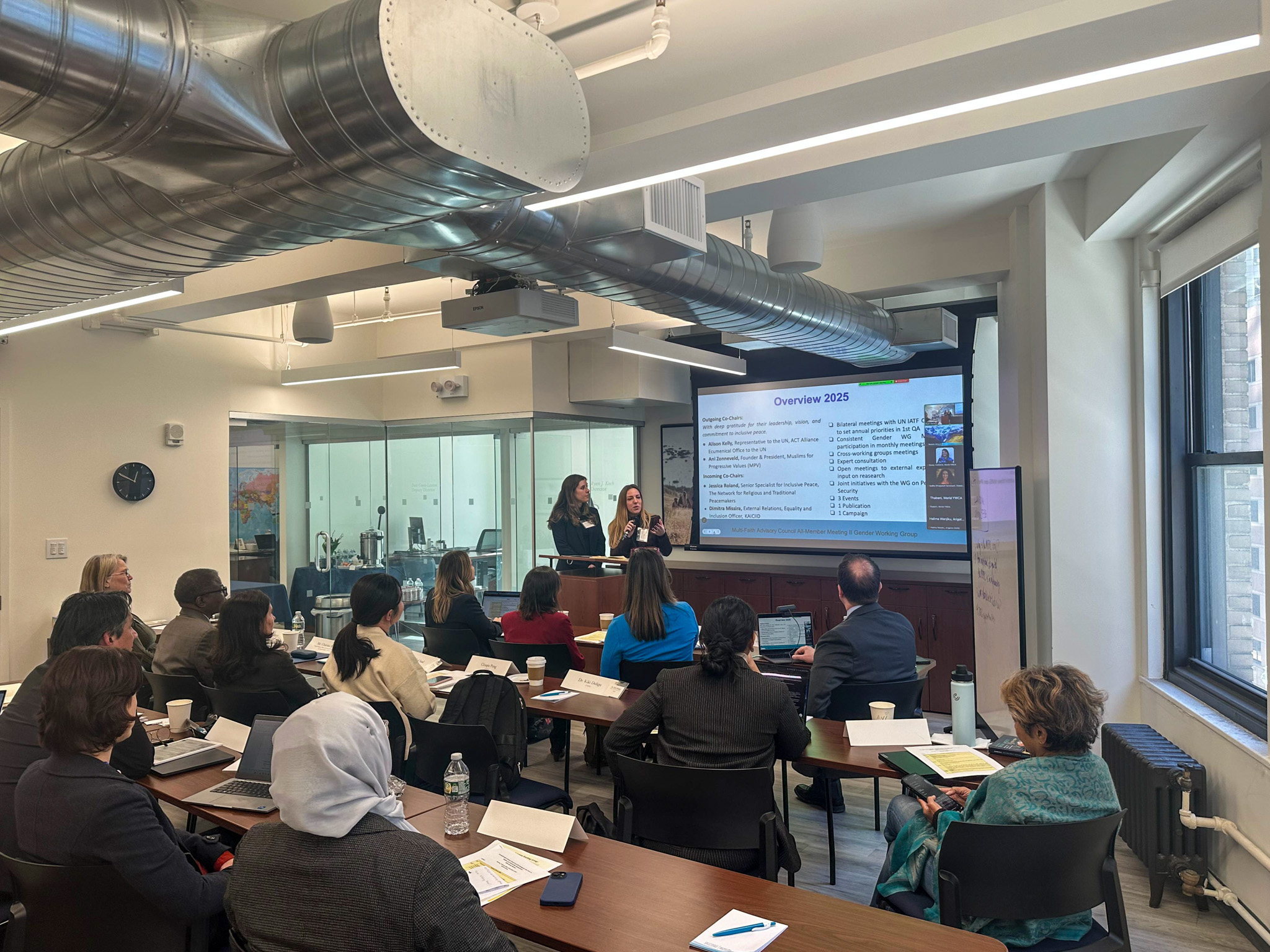
The International Dialogue Centre - KAICIID concluded its recent works at the United Nations in New York by joining multifaith and UN partners at the 2026 annual retreat of the Multi-Faith Advisory Council (MFAC) to the UN Inter-Agency Task Force on Religion and Sustainable Development. As an MFAC member and co-chair of the Council’s Gender Working Group, KAICIID contributed to discussions shaping MFAC’s 2026 priorities on prevention, peace and social cohesion, as well as the role faith actors can play in advancing coordinated engagement across UN processes.
The retreat also provided an opportunity to connect MFAC’s planning with outcomes from KAICIID’s wider UN engagement, including the signing of a Memorandum of Understanding with the United Nations Office of the Special Adviser on the Prevention of Genocide.
Held during World Interfaith Harmony Week, the retreat was hosted at the New York offices of The Church of Jesus Christ of Latter-day Saints, an MFAC co-chair institution. Participants reviewed the Council’s progress since 2019, took stock of thematic working group activities and agreed on areas where multifaith networks and UN entities can strengthen collaboration across peace, development and human rights.
The retreat brought together MFAC co-chairs and working group leads alongside representatives of the UN Inter-Agency Task Force, including senior officials from the United Nations Alliance of Civilizations (UNAOC), the United Nations Population Fund (UNFPA) and the UN Office on Genocide Prevention.
Participants returned repeatedly to the importance of values-based engagement, often described as spiritual diplomacy, as a practical approach to prevention that connects human dignity, social cohesion and ethical responsibility with global commitments under the Sustainable Development Goals.
Discussions focused on how faith actors can help bridge divides, counter dehumanising narratives and support early, community-rooted efforts to prevent violence and atrocity crimes. Strengthening coordination among multifaith networks was highlighted as critical to ensuring that perspectives grounded in lived realities and community trust are reflected more consistently in policy debates.
Participants noted that, despite growing recognition of religion’s relevance in peacebuilding and development, policy and research agendas do not always reflect how religious actors, institutions and ideas can shape outcomes on the ground. At the same time, many faith-based actors lack access to the policy language and entry points needed to engage effectively with multilateral systems.
MFAC members underscored the value of two-way learning: strengthening religious literacy within international institutions while also supporting faith partners to translate local experience into policy-relevant evidence, examples and narratives. Platforms such as MFAC were positioned as practical bridges between global commitments and community-level implementation.
The retreat showcased how multifaith collaboration is advancing through MFAC’s thematic working groups, including peace and security, gender equality, climate and nature, youth engagement and multilateral cooperation.
As co-chair of the Gender Working Group, KAICIID shared updates on efforts to anchor MFAC’s gender equality agenda in UN processes. This included engagement around the 30th anniversary of the Beijing Declaration and Platform for Action, consultations with UN partners to shape a roadmap, and the development of advocacy products focused on narratives around SDG 5 – whose core objective is to end discrimination, violence and harmful practices against women and girls, while ensuring equal opportunities in political, economic and social spheres. The group also led MFAC’s 16 Days of Activism campaign, “Faith in Action: Reclaiming Sacred Texts for Equality” and is preparing the launch of the Side by Side Compendium at the Commission on the Status of Women, alongside practical tools to support uptake within faith communities.
Looking to 2026, participants highlighted the need for more proactive multifaith engagement on emerging risks, including genocide prevention and early warning, countering antisemitism and Islamophobia, and expanding work at the intersection of gender equality, population dynamics and faith-based advocacy.
The role of artificial intelligence in amplifying harmful narratives was raised as an area where closer cooperation between faith actors and international institutions could support ethical approaches, reduce dehumanisation and strengthen community resilience.
The retreat reaffirmed that breaking down silos between secular institutions, faith-based actors and multilateral systems is not only possible but necessary. By building trust and practical cooperation across institutional and religious lines, MFAC partners aim to strengthen coordinated engagement that advances prevention, protects human dignity and supports peaceful coexistence.
For KAICIID, the retreat reaffirmed the importance of its contribution as an MFAC member and co-chair of the Gender Working Group, along with its broader role in connecting multifaith partners with UN entities on prevention, social cohesion and inclusive policies. Building on the outcomes of the New York mission and the MFAC retreat, KAICIID will continue working with MFAC co-chairs, working groups and UN partners to advance values-based approaches to prevention and more coordinated engagement across the UN system in 2026.
The Multi-Faith Advisory Council (MFAC) was convened in 2018 as an informal, voluntary platform bringing together faith-based partners engaged with the UN system, reflecting diverse religious traditions and global representation.
MFAC provides strategic advice and supports coordination between faith-based actors and UN entities working across peace, sustainable development and human rights.
MFAC advances its work through thematic working groups, including gender equality, peace and security, global governance and multilateralism, and environment and climate change.